"You're bone on bone."
What that actually means.
It is the phrase almost everyone hears right before the conversation turns to surgery. It is also frequently misunderstood, occasionally overstated, and not by itself a reason to book an operation.
Cartilage is the smooth, slick tissue capping the ends of your bones inside a joint. It has no nerve endings and no blood supply, which is why it does not repair itself and why the early stages of wearing it away are painless. "Bone on bone" is shorthand for the endpoint: enough cartilage is gone that the bone surfaces contact each other directly. Bone does have nerve endings. That is where the pain comes from.
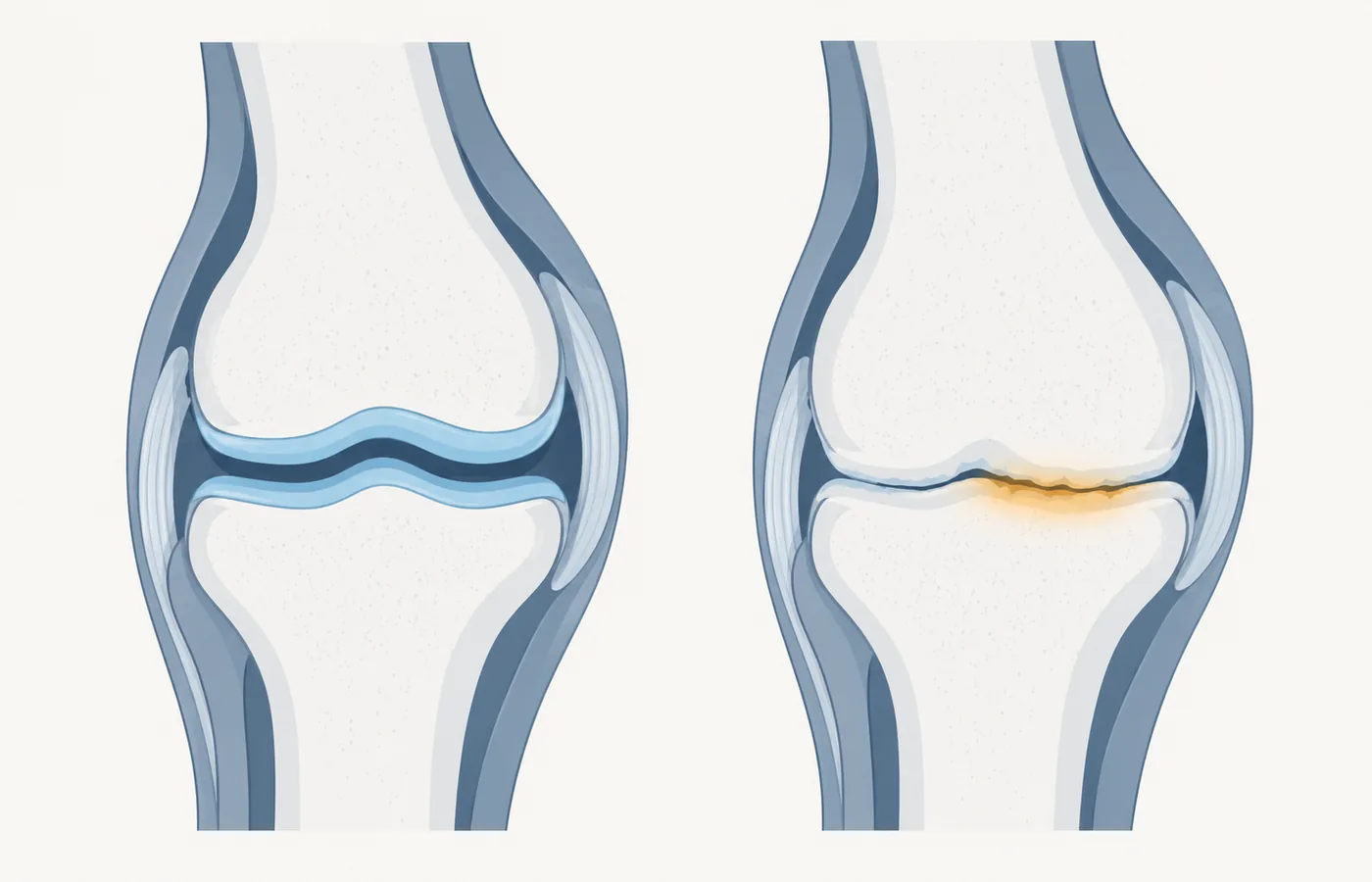
The cushion on the left is what you are missing on the right.
What the grading actually says
Radiologists commonly describe knee arthritis using the Kellgren-Lawrence scale, which runs from 0 to 4 based on what shows on an X-ray — joint space narrowing, bone spurs, and changes in the bone beneath the cartilage.
| Grade | What the X-ray shows | Typical implication |
|---|---|---|
| 0–1 | Normal or doubtful narrowing, possible tiny spurs | Not arthritis in any meaningful clinical sense |
| 2 | Definite spurs, possible mild joint space narrowing | Mild. Conservative management is the standard path. |
| 3 | Multiple spurs, definite narrowing, some bone sclerosis | Moderate. Many people function well here for years. |
| 4 | Large spurs, marked narrowing, severe sclerosis, deformity | Severe — this is the "bone on bone" grade |
The single most important thing to understand: imaging severity and pain severity correlate poorly. There are people walking around with grade 4 changes and manageable symptoms, and people with grade 2 changes who are genuinely miserable. Surgery is indicated by how much your life has narrowed, not by a number on a report. A surgeon who wants to operate based on your X-ray without a long conversation about your function is skipping the important part.
What is usually tried first
Most surgeons and most insurers expect a documented attempt at conservative management before replacement. It is worth doing genuinely rather than as a box-check, because some people get years out of it.
- Targeted strengthening. Quadriceps and hip abductor strength meaningfully changes knee loading. This is the intervention with the best evidence and the one most often done half-heartedly.
- Weight management where applicable. Load through the knee multiplies body weight during normal gait, so modest changes have outsized mechanical effects.
- Activity modification. Not stopping — substituting. Swimming, cycling, and elliptical work maintain conditioning without the impact.
- NSAIDs and topicals. Under medical supervision, with attention to kidney, GI, and cardiac considerations.
- Corticosteroid injections. Reliable short-term relief for many people. Frequency is limited because of cartilage and infection-risk concerns, particularly close to a planned replacement.
- Hyaluronic acid injections. Evidence is genuinely mixed and major guidelines differ on recommending them. Some people report benefit.
- Bracing and offloading. Can help meaningfully in single-compartment disease with malalignment.
A note on the treatments that get marketed hardest: platelet-rich plasma and stem cell injections are widely advertised for arthritis, and the evidence for structural cartilage regeneration in an established grade 4 joint does not currently support the claims made in most advertising. If you are exploring regenerative options, look at how they are regulated and what evidence level each intervention actually has — ColombiaStemCellTreatment.com covers the INVIMA regulatory framework and evidence grading in detail.
How to tell it is time
There is no formula, but the questions that tend to matter are functional rather than radiographic:
- Does the pain wake you up at night, or persist at rest?
- Have you stopped doing things you care about — not sports necessarily, but stairs, groceries, standing through a conversation?
- Have you exhausted reasonable conservative management, honestly rather than nominally?
- Is the joint deforming, or is the limp changing how your other joints and your back feel?
- Are you organizing your day around the pain?
When several of those are yes, replacement moves from an option to a reasonable plan. When they are not, waiting is a legitimate medical strategy and not a failure of nerve.
Then, and only then, the money question
Once a surgeon has told you it is time, the cost conversation starts — and that is where the American system tends to produce the second shock. A knee that costs $17,679 as a published cash bundle at a transparent surgical center can be billed at $45,000 by a hospital forty minutes away, and neither number is visible until you are already in the process.
That gap, and the international one behind it, is what the rest of this site is about.
Not sure whether it's time yet?
That is a question for a surgeon who has seen your imaging, not for a website. What we can tell you is what it costs once you get there, and how to check that whoever is quoting you is who they say they are.
One vertical of a larger research project
Joint Replacements is the orthopedic arm of a Colombia-focused medical travel network. Same standards, same person behind it, different procedure.